

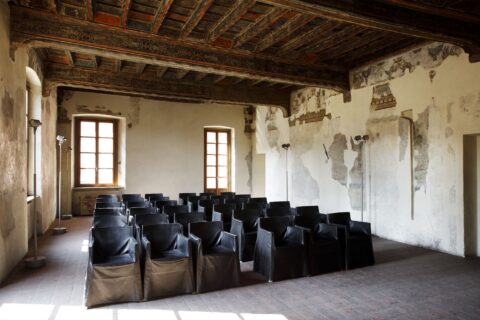
The frescoed salon on the first floor is, among all the spaces in Casa del Pingone, the one that offers us the most clues about the history of the palace. The walls, restored by the R.i.c.t. Tauro team led by Marina Locandieri under the supervision of architect Paola Salerno and Dr. Cristina Mossetti of the Superintendence, have been revealed to be very ancient, likely dating back to the same period as the medieval tower. There are no traces of additional floors on the facade, and the masonry of the tower itself is interlocked with that of the main wing facing the courtyard. The staircase, however, was built in a later phase, perhaps at the end of the 16th century, and to construct it, the entire southeast side of the tower was demolished, which now serves as the distribution element connecting the various floors of the House.
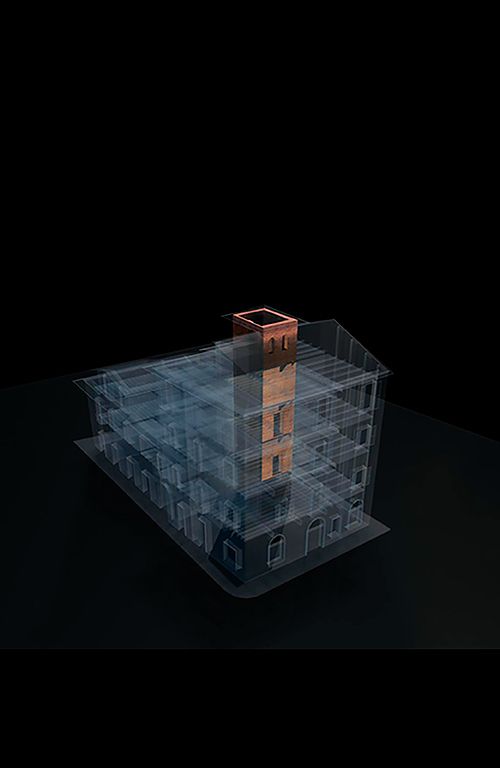
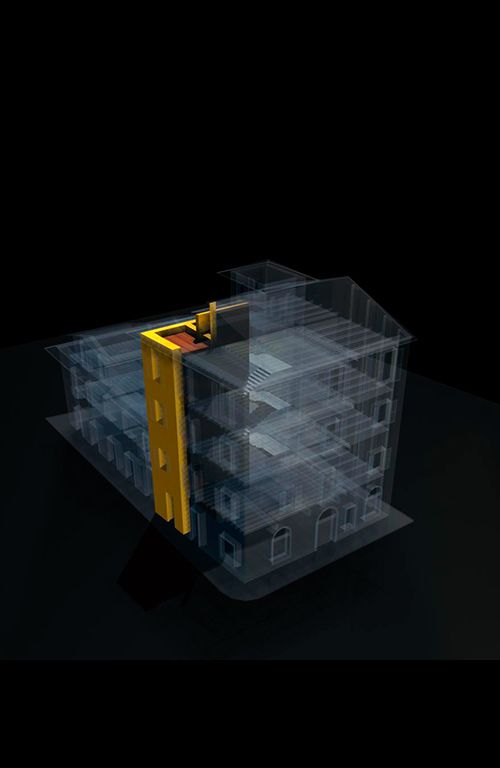
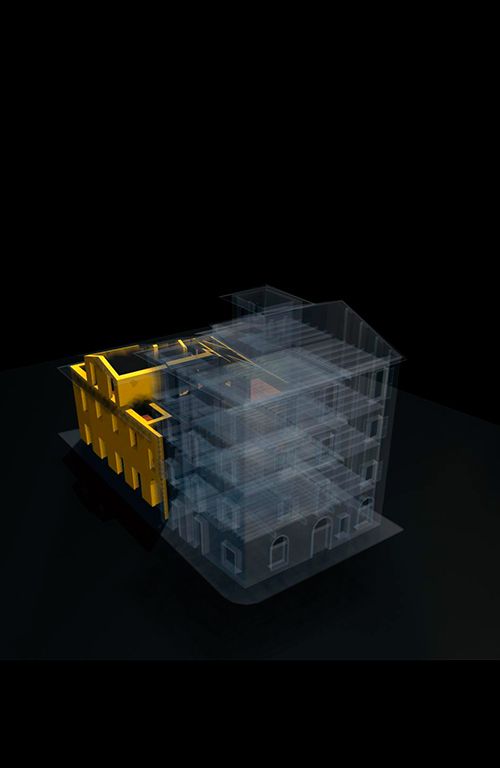
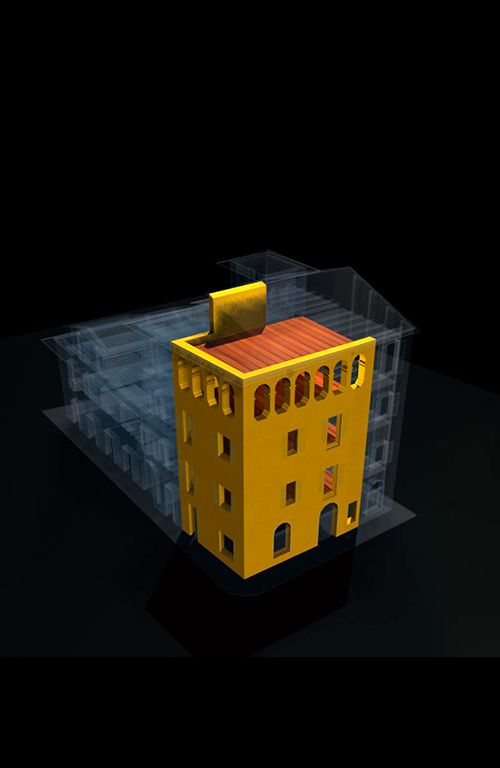
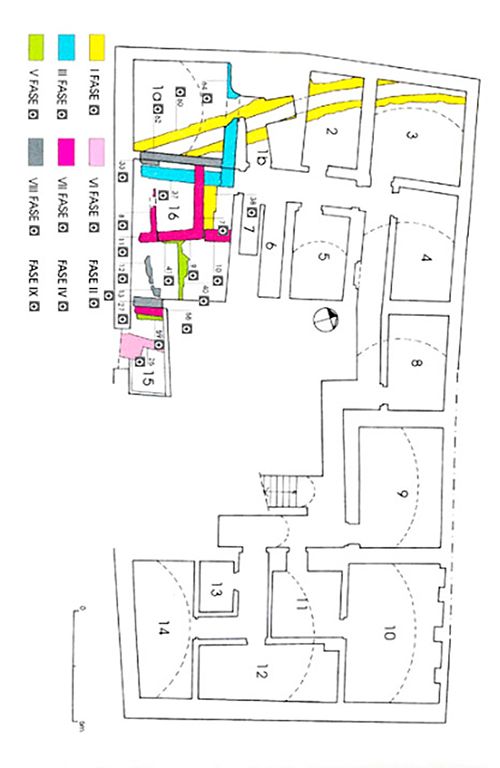
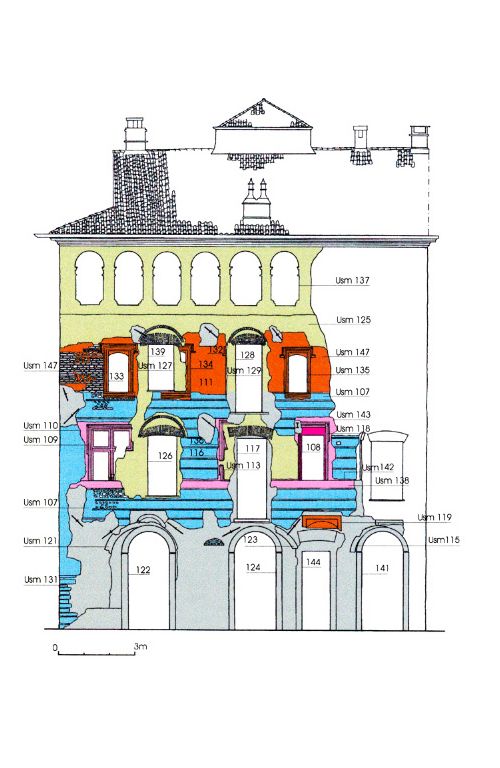
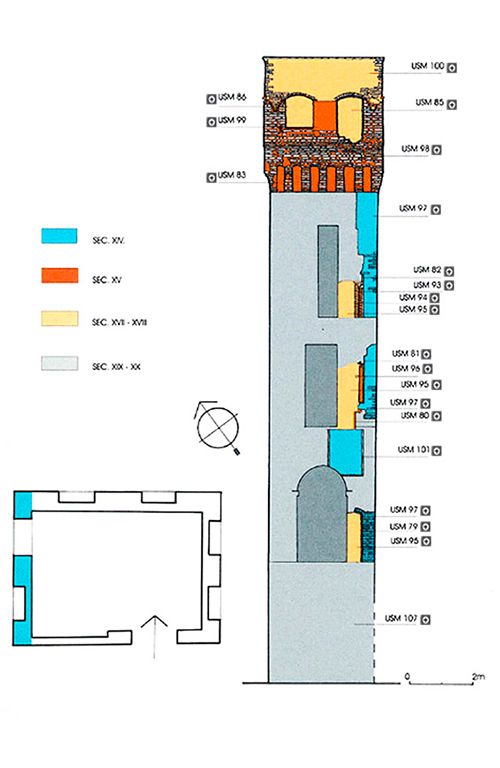
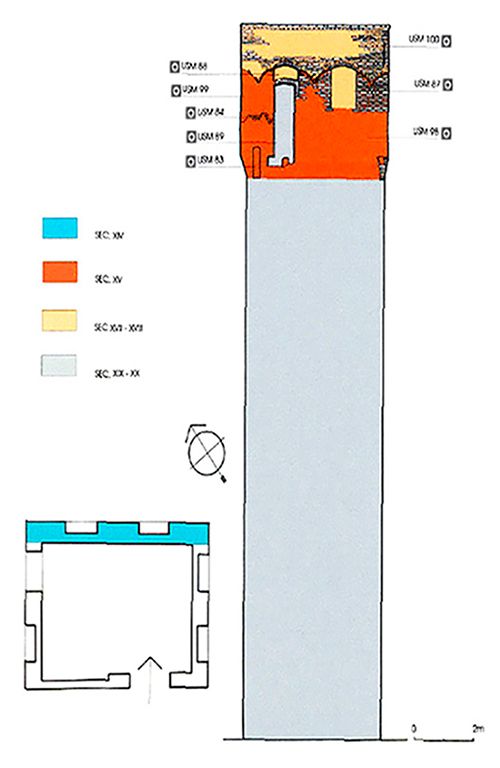
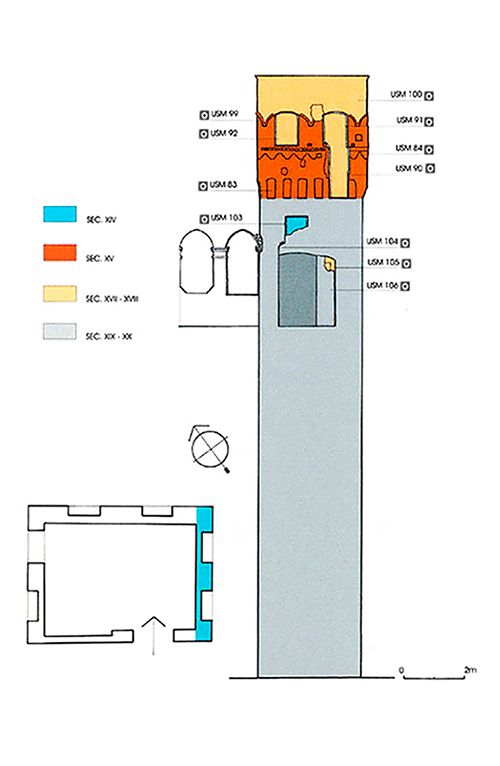
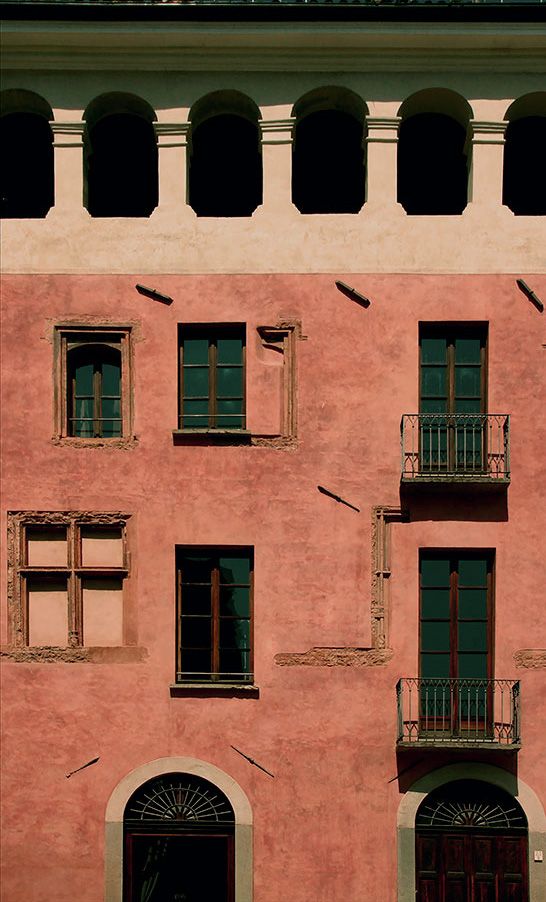
The overlapping layers of plaster found on the walls of the first-floor salon reveal at least two main periods among the oldest: the first dating back to the late 15th to early 16th centuries, a time when the entire building had windows framed by terracotta decorations. These were discovered beneath a thick layer of 20th-century plaster and left exposed on the facade. Alongside the terracotta moldings, fragments of red plaster with white linear detailing (perhaps imitating brick patterns) were also found, inspiring the current coloration of the building’s facade.
In several areas, the 16th-century plaster in the salon curves back at the level of the old windowsills and is absent for about thirty centimeters above the floor. This suggests that the floor slab between the ground and first floors may have originally been slightly higher. The ground floor also appears to have been raised, implying that the level of the shops might have initially been high enough to include a mezzanine.

The painted decoration of this first plaster layer consisted of a band approximately sixty centimeters high depicting a curtain pattern repeated along the entire perimeter of the room, topped by landscape panels separated by painted pilasters with candelabra motifs reminiscent of the pilasters in the nearby Duomo by Meo del Caprino, which likely served as inspiration.
Between these architectural elements, which extend into the beams of the rich polychrome wooden ceiling (restored by Tiziana Sandri), opens a trompe l’oeil landscape of hills and distant mountains with several groups of houses. Unfortunately, not much more is distinguishable, and it was decided not to remove the overlapping layers of plaster (where they remain intact), thereby resigning to the potential loss of additional decorative details that might have enriched these glimpses of 16th-century Turin. Scratched into the plaster, a name—perhaps “Belardo”—was found, maybe a former resident of the house or the painter of the fresco.
While the typically late medieval style of the tower and window frames suggests that the original construction of the wing facing the Cardo Maximus of the “city square” dates to the 15th century, built on pre-existing foundations, the second layer of plaster in the salon sheds light on a significant renovation of the building, difficult to date with certainty.
This renovation may have occurred during the years when the house was inhabited by Emanuele Filiberto Pingone, which is why our interest has focused on this intervention.
The suggestion that Pingone—an important and powerful figure at the Savoy court—lived here comes not only from popular tradition but also from the sole documentary source: Luigi Gramegna’s historical-literary novel of 1906, in which our palace is identified as the residence of the historical figure. The grotesque frescoes in the upper band, close to the ceiling, are partially painted over the infill walls of medieval window openings, indicating that the new pictorial cycle is contemporary with or subsequent to a more radical architectural and stylistic reshaping of the building. It is natural to assume this renovation occurred after Turin was chosen as the capital of the duchy in 1563 and the consequent newfound centrality of this small Piedmontese settlement. One hypothesis is that Filiberto Pingone, who arrived in Turin with the court and died there in 1582, commissioned this important renovation. The subjects of the fresco cycle are inspired by pagan classicism, typical of grotesques spread throughout Italy during the 16th century. The grotesques of Casa del Pingone are also laden with references and allusions to symbols and figures from the alchemical and esoteric worlds. Several sources attribute alchemical knowledge and expertise to Pingone, and certainly the Duke’s own library was rich with volumes and writings by great European esotericists. It is significant that the Savoy court, despite strict adherence to Counter-Reformation dictates, tolerated an artistic culture quite permeable to Renaissance Neoplatonic and Hermetic reminiscences and influences.
According to this dating hypothesis, the grotesques of Casa del Pingone would be a unique testimony in Turin to the cultural climate of late 16th-century Europe and would offer a complementary perspective to the repressive policies implemented by the Duke toward reformist movements, particularly in the Alpine valleys and territories near Switzerland.
A second hypothesis, not necessarily contradicting Pingone’s presence during his years in Turin, places the pictorial cycle half a century later, after 1630.
This other hypothesis is supported by the presence in the painted cycle of three surviving monograms (though there were almost certainly others). The central one—bearing the initials F and T placed above the Savoy knot and topped by the marquisial crown—has long intrigued us. This first monogram is composed of an F and a T.
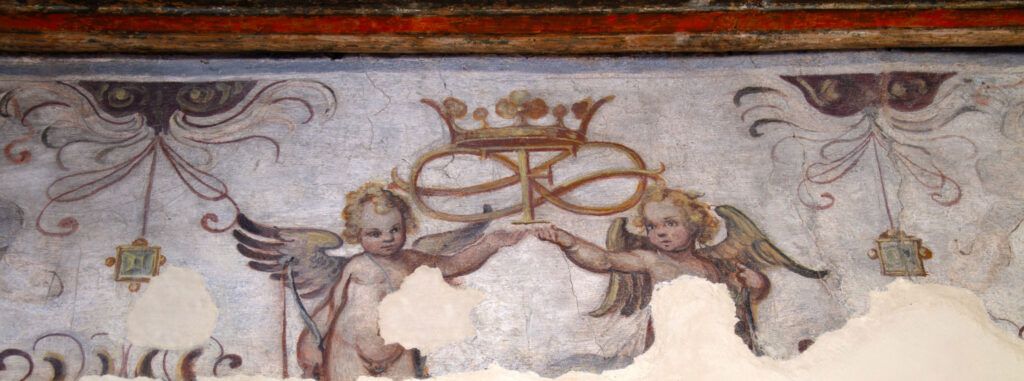
By delving into the complex genealogy of the House of Savoy, we must shift our focus to the time of Tommaso Francesco di Savoia, son of Carlo Emanuele I and Caterina Michela of Habsburg. Tommaso held the titles of Marquis of Salussola, Marquis of Bosque and Châtelard, Marquis of Racconigi, Count of Racconigi and Villafranca, Knight of the Annunziata, Grand Master of France, and most notably, from 1620, Prince of Carignano, thus founding the Savoia-Carignano branch.
In 1625 , Tommaso married Maria di Borbone in Paris, and the following year, their first of seven children, Cristina Carlotta, was born. She died shortly after birth, and it is possible that part of the pictorial cycle was dedicated to her memory.
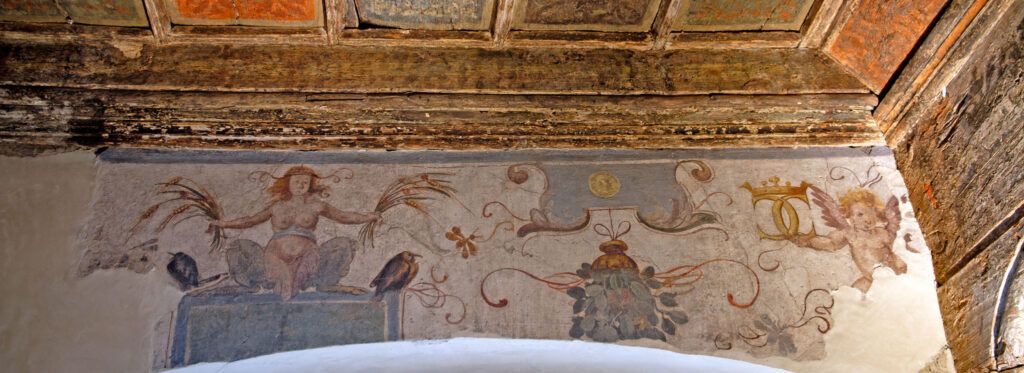
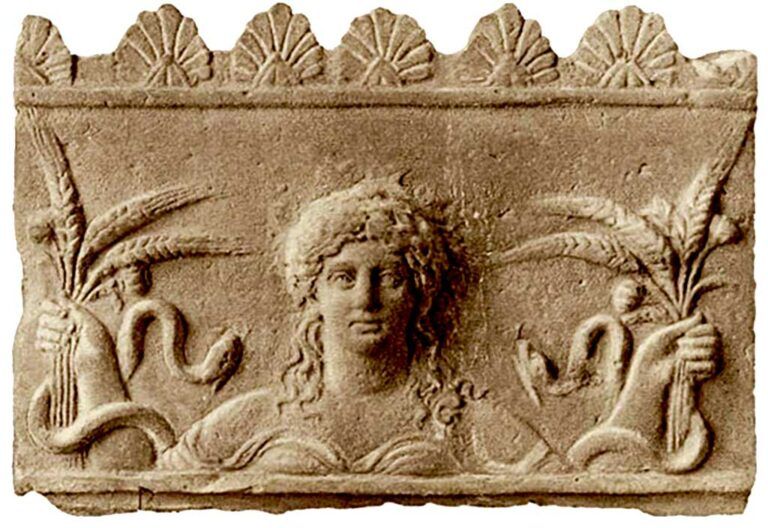
The second recovered monogram consists, in fact, of a double intertwined C held aloft by a small angel who seems to elevate it toward the sky. This hypothesis is further supported by the presence of a particular figure—that of a hermaphrodite clutching ears of wheat, seated on a sarcophagus flanked by a pair of ravens. This fascinating iconography draws from classical imagery related to the cult of Ceres, the goddess of abundance and fertility, who also served as a bridge to the underworld.
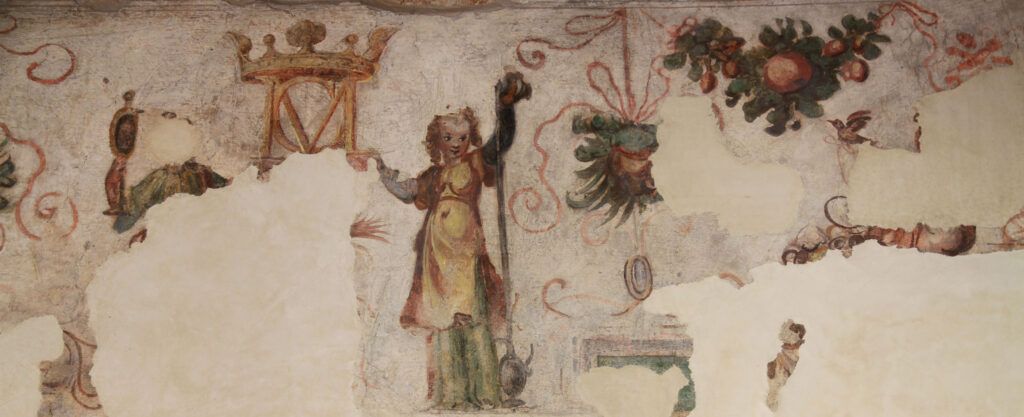
The third monogram, more difficult to decipher, is composed of two or three letters that could be a C or a G and an M or a V. A curious aspect of this monogram, like the first one crowned by the marquisial crown, is that it originally included the Savoy knot, which was sketched (its outline is still visible under raking light) but not executed in the final painting. The letters identified could refer to Caterina Michela of Habsburg, mother of Tommaso Francesco. Here too, the figures supporting the monogram contain clear references to alchemical symbolism, featuring imagery such as the water bearer (Aquarius) and the mirror.
It is likely that the missing parts of the cycle contained other monograms, which might strengthen the centrality of Prince Tommaso’s family and further clarify the meaning of the fresco. However, the reconstruction seems fairly convincing, particularly when considering the direct lineage of the three figures linked to the monograms.
Assuming the letters were not added later, the fresco would therefore date after 1626, the year of Cristina Carlotta’s death, a period when the so-called “Carlo Emanuele I” painting style—compared to contemporary decorations at the Castello del Valentino—was already in decline. One possible explanation is the desire of pro-Spanish princely factions to appeal to tradition in order to exalt the virtues of a nobility that looked to the Empire and to the not-so-distant era when Emanuele Filiberto defended Savoyard autonomy from French encroachment—justifying such a nostalgic choice.
We have no evidence compelling us to assume that the architectural transformation—eliminating the medieval windows and lowering the floor between the first and second floors—occurred simultaneously with the second pictorial cycle. However, it is reasonable to think that this reorganization of levels was carried out to create an important formal salon on the main floor, consistent with the presence of a member of the Savoy family—even if long exiled.
A compromise hypothesis also remains plausible: that the transformations of Casa del Pingone were executed in multiple phases. The first phase, driven by the urgency to modernize the image of the capital, and the second, to enrich the ceremonial salon with a commemorative fresco cycle.
A further discovery supporting the placement of the pictorial cycle in the third decade of the 17th century is the carved head that supports a first-floor balcony on the side facing Via Porta Palatina.
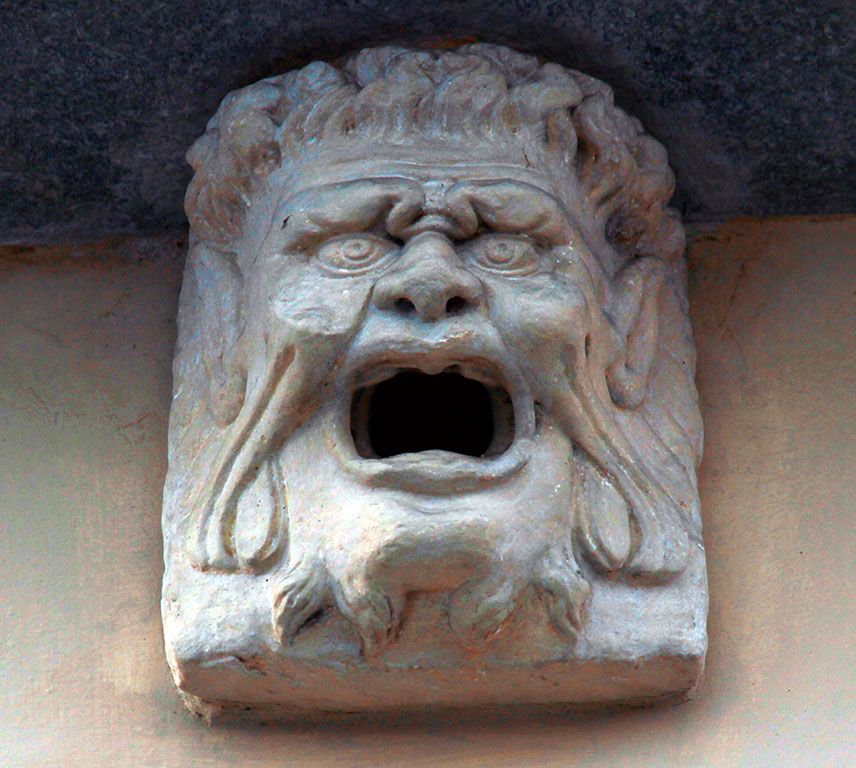
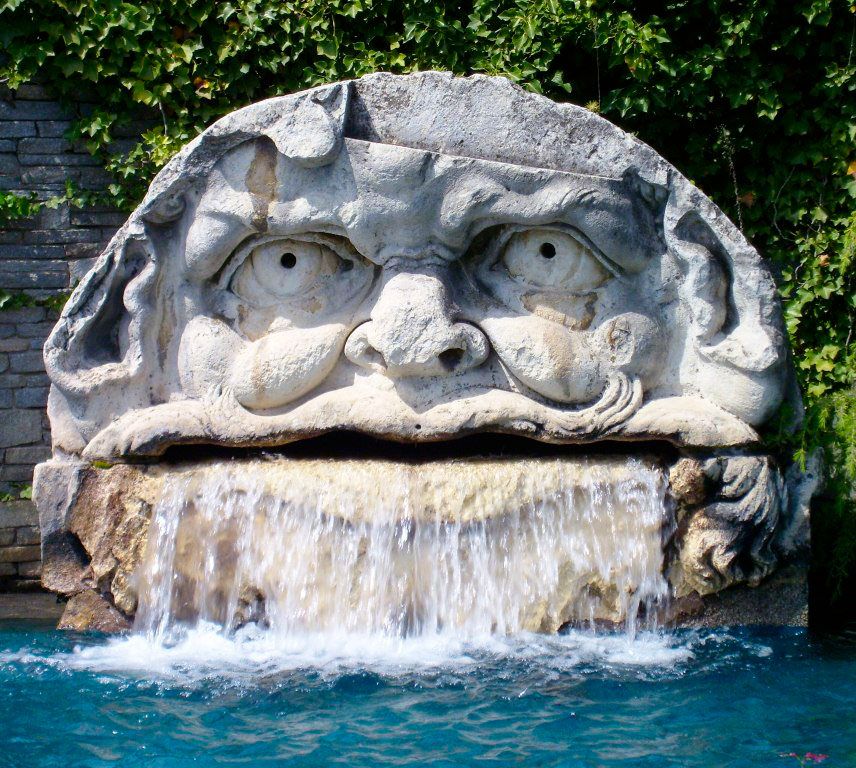
The carved grotesque mask is certainly a reused element, located on the lower wing of the building facing Via Egidi, which was likely reconstructed in the 19th century. We do not know the exact nature of the pre-existing building, but archaeological excavations indicate that structures from various earlier periods existed on the site, dating back to Roman times. Given the size of the foundations, it is plausible that at least some portions of the building were developed vertically, and a larger courtyard cannot be ruled out.
The mask almost certainly belonged to a fountain, which could have been located inside the courtyard. Stylistically and in terms of material, it recalls the work of the Piedmontese sculptor Giacomo Fontana, who in 1622 created the far more imposing grotesque mask in Chianocco stone for Cardinal Maurizio to adorn the abbey park of Giaveno.
The significance of the summer residence in Giaveno is documented by the presence of Carlo Emanuele I and Caterina Michela of Habsburg as early as 1586 for several summer stays.
The choice of an artist linked to Cardinal Maurizio may be significant, as among all the brothers of Vittorio Amedeo I, he was the closest to Tommaso Francesco.
After the death of Vittorio Amedeo I in 1637, his wife Cristina of France assumed the regency on behalf of their son Francesco Giacinto. Only a year later, Francesco Giacinto died, leaving the right to the throne to his younger brother Carlo Emanuele II, still a child, who had to wait until 1648 to rule. The struggle for regency at that point involved Vittorio Amedeo I’s brothers, Maurizio and Tommaso, who pursued a pro-Spanish policy and in 1639 occupied Turin, claiming the right to the regency until 1642, in opposition to the madamisti, who supported Madama Cristina.
The presence of Giacomo Fontana as the sculptor of some now-lost details of Casa del Pingone could therefore align with 17th-century use by members of the princely faction close to Tommaso Francesco, if not by the prince himself during his rare stays in the city.
Text by Luca Emilio Brancati and Federico De Giuli
