

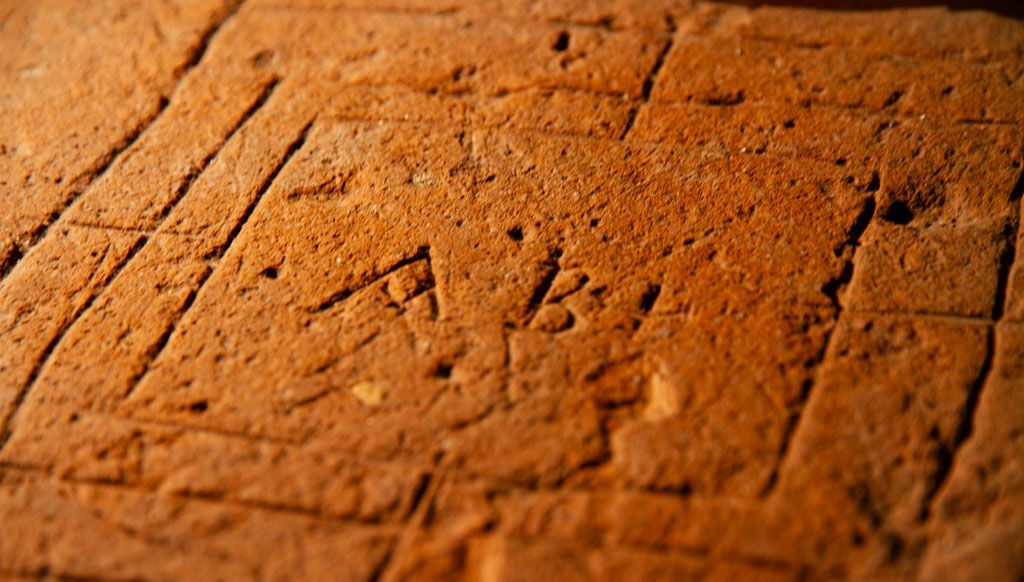
A curious discovery made during restoration work in 2001 is a Roman brick inscribed dry, presumably in the medieval period, with three concentric squares connected by four perpendicular lines at the midpoints of the sides. Inside the center are three characters resembling the letters “AB” followed by a cross.
The symbol, known as the triple enclosure, is widespread across Europe, beginning with surviving rock carvings from Celtic populations, and has been used with multiple meanings throughout subsequent history.
The prevailing interpretation links it to a sacred place or temple, understood as a divine city: the Jerusalem with twelve gates (Revelation 21:10-27), Atlantis, or as representing levels of human interiority.
The same pattern often appears behind the checkerboard of the game of draughts (checkers) and is used to play tic-tac-toe or nine men’s morris—a game where the goal is to occupy three stations in a row with one’s pieces.
The variations in which hundreds of triple enclosures have been carved and cataloged by enthusiasts are numerous. They may include diagonals and often feature a kind of central hole at the point where the perpendicular lines hypothetically intersect. In our case—though not the only one—the central field is occupied by three signs that are difficult to interpret.
One hypothesis that may have some basis is the resemblance of the inscription to a detail from the engraving on the tombstone of a Lombard Duke of Turin. Aubaldo governed the city in the 9th century, and little is documented about his life. The funerary stele, reproduced below alongside our brick, is preserved in the Museum of Antiquities in Turin.

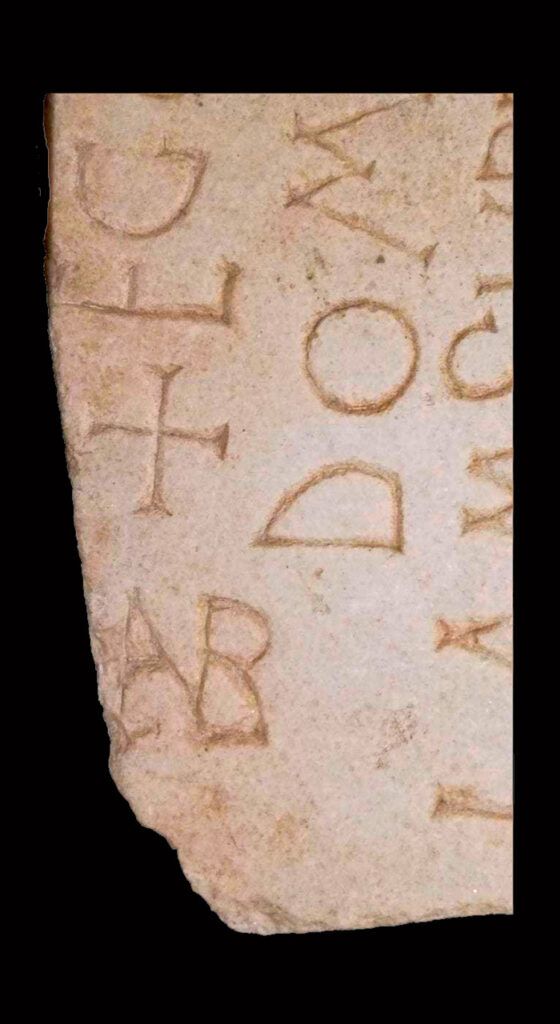
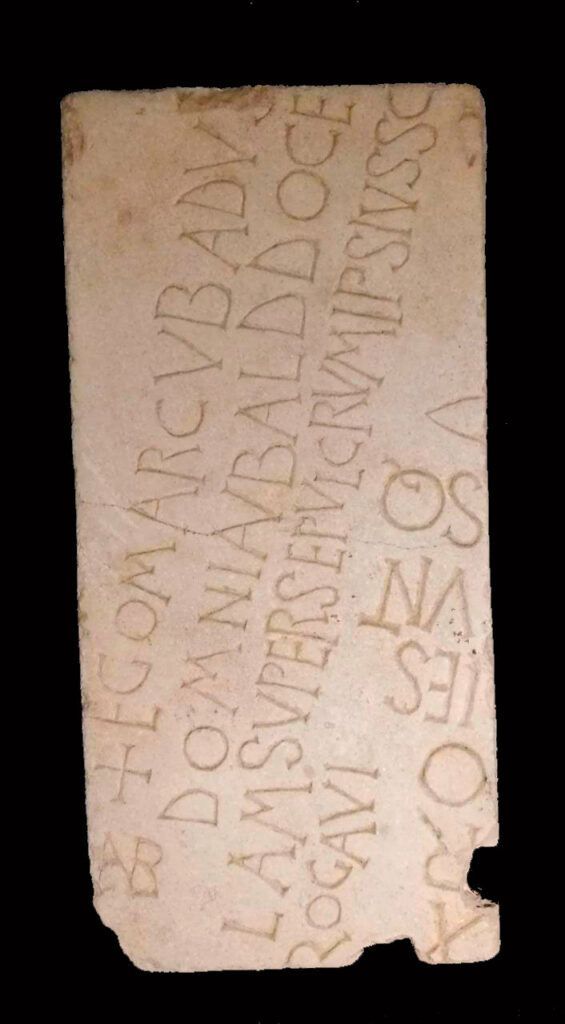
Beyond a vague morphological similarity, we have no documents that could link the two inscriptions. The brick discovered during the demolition of an interior wall at Casa del Pingone is clearly a repurposed Roman material, and the engraving appears to have been made after the clay was fired. If the hypothesis that dates the inscription to the 9th century were valid, it would represent an intervention predating the construction of the house. Consequently, the brick could have been part of another wall between its initial use and its recent rediscovery in its current location.
